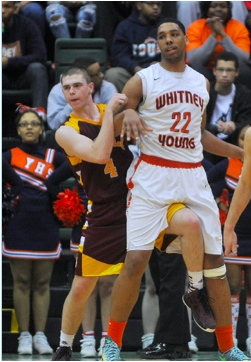
How to Stop Jahlil Okafor
1

“I see nothing.”
By now you surely know the broad outlines of the story. No need to recount all of the sordid details here.
Over a span of eighteen years, stretching from coaching legend Dean Smith to Hall of Famer Roy Williams, 3,100 students – nearly half of them UNC athletes – enrolled in a series of sham Afro-American Studies courses guaranteeing them A’s and B’s without having to show up for class, turn in papers, or take tests. Most of the jocks were football and basketball players, including members of three national championship teams (1993, 2005, 2009).
 At the center of the “shadow curriculum” was an assortment of “paper classes” or independent study courses coordinated by Deborah Crowder, a secretary in the AFAM program. These courses proceeded without the involvement or supervision of UNC faculty and required only a single research paper graded, of course, by Crowder, resulting nearly always in a high grade or more disturbing, the specific grade required to keep the particular athlete eligible. If the athlete needed a “D-plus” to generate a GPA high enough to guarantee eligibility, then he received a “D-plus.” If he needed “C-minus,” he got a “C-minus.”
According to Kenneth Wainstein, a former US Department of Justice official hired by the University to investigate the scandal, “By the mid-2000s, these classes had become a primary – if not the primary way – that struggling athletes kept themselves from having eligibility problems.” For example, ten of the fifteen players on the 2004-05 North Carolina men’s basketball team majored in AFAM. How many of them would have remained eligible without the sham courses? Wainstein’s probe didn’t pursue the question but the NCAA is now investigating former players’ transcripts to see if the phony classes enhanced their eligibility.
And Roy Williams’ culpability? Continue reading…
One month down, four to go, and time for me to start blogging again.
Since early October we’ve been treated to a litany of articles previewing the 2014-15 season. Virtually all of them speculate on who will ultimately emerge as the best team and the top players. I’d like to go in a different direction, probing trends in strategy and philosophy, and as indicated in the tag line for this blog, “challenging basketball’s conventional wisdom.”
In no particular order here’s what I hope to explore as the season unfolds:
• Basketball’s talking heads frequently cite the importance of “making the extra pass.” But how many passes are actually required to produce a quality shot? Is an offensive scheme that produces quality shots after multiple passes inherently more effective than one that generates such shots more quickly with fewer passes? Do the odds of a turnover climb as the number of passes and length of possession increase? Are fewer passes indicative of “poor coaching” or an “undisciplined team”?
• Will players finally adjust to the new hand checking rules and commit to playing defense with their feet? Will the so-called “traditionalists” who spent the better part of last season griping about the rule changes finally admit that mugging one’s opponent was never actually part of the game’s origins and that “taking the charge” — while often gutsy — is not really a “basketball” skill? Will the intended “freedom of movement” actually take effect, leading to more baskets, fewer trips to the charity stripe, and a more esthetically pleasing game?
• Will John Calipari’s platoon system bear fruit? How will it change and morph as season progresses? Will it unfold in a series of five man waves or other kinds of combinations? How will the loss of Alex Poythress affect the scheme? What will happen when a game is on the line?
• Bill James, the legendary amateur baseball statistician and father of “sabermetrics,” defined his work as “the search for objective knowledge about baseball.” The analytic revolution he inspired has now found a place in virtually every sport including basketball. Coaches and roundball aficionados are uncovering fascinating trends and patterns through data mining and analytics. But what are the limits? At what point does the sheer volume of data dwarf its practical application? How do you “see through” or “around” the data points to the actual game? Unintentionally, does an emphasis on data mask the simplicity of the game and complicate the strategic coaching choices? Teams and particular styles of play may emerge as statistically “efficient” but are they necessarily “effective”?
• Is blocking out necessary for effective rebounding? Traditionalists insist on its importance, but John Wooden didn’t think so and neither does Bill Bradley. Who’s right?
• Is the midrange jump shot dead and buried or waiting to be re-discovered? What conclusions emerge when we map the effectiveness of shooting across the full spectrum of distinct spots between the 3-point line and the rim instead of collapsing all of those spots into one statistical area loosely defined as the “midrange”? What happens when we apply Sandy Weil’s optical tracking analysis of shooting, measuring not only where a particular shot takes place but how it occurs? What might happen if players were re-schooled in the traditional mid and short range jumper, the pull-up, and the bank shot, and if offensive schemes catered to creating such shots? Can we create a whole new generation of shooters – able to shoot from a variety of spots, especially in traffic? Would pace and scoring actually climb and the quality of the game improve?
• On the eve of last season’s NCAA Championship t.v. analyst Kenny Smith picked Connecticut to defeat Kentucky in the big game arguing that he favored “basketball players” over “athletes.” How do you select players to build a team? What criteria do you use?
• Football coaches use various offensive formations and alignments to create “mismatches in space” and ways to outnumber the defense at the point of attack. Is it possible for basketball coaches to do the same? Even in an era of no huddle, hurry-up offense, football games come to a required stop as each successive play is whistled dead and the teams re-align for the next snap, but basketball is a game of continuous action with the teams seesawing back and forth between offense and defense often without any stops. So is football-style “formationing” actually possible in a basketball game?
• Coaches try to control two fundamental elements that make up many team competitions — time and space. What is the relationship between these two elements in basketball? How does that relationship affect the game’s affect strategic and tactical choices?
• Last year John Calipari once again took a team to the Final Four. Is he a master tactician, a great recruiter, a bandit, or all of the above? In an era of AAU, one-and-done, and frequent transfers does he represent the worst in collegiate basketball or is he actually the most honest coach in the business?
• In early October ESPN’s Eamonn Brennan asked “Is Scoring Stuck?” Then, several weeks ago statistical guru Ken Pomeroy chimed in, speculating that we are about to experience the slowest season in history of college basketball. If the early season trends hold, Pomeroy believes that “possessions per 40-minutes” are likely to fall to 65.0, leading to the lowest scoring season since 1952. Ironically, implementation of the three-pointer and shot clock in the mid-1980s, coupled with their subsequent refinement and the recent “freedom of movement” rule changes, were intended to open the floor and reverse the downward slide. Yet scoring and pace remain stuck or once again in decline. Why? Will reducing the shot clock further, lengthening the three-point line, and widening the lane – changes now being discussed – finally correct the problem or does the real culprit lie elsewhere?
You’re cordially invited to participate in the better than a layup NCAA Tourney Pool! I’ve set up a bracket at CBS Sports and hope that you’ll join in the fun.
To accept my invitation, click the link below and when you arrive at the site, register with CBS Sports. It takes about three minutes and requires you to enter an email address and set a personal password. Very easy.
Once that’s done, you’ll be directed to our better than a layup page where you can fill in your bracket. To get started, you’ll be asked to enter our group password — seeberg. It’s that simple.
Here’s the link.
http://betterthanlayup.mayhem.cbssports.com/e?ttag=BPM14_em_cbsinv
Oh… and the winner? Will he receive a billion dollars? Not from me, but if he’s willing to be acknowledged, I’ll conduct a brief “interview” and announce his or her name here at better than a layup. This could be your 15 minutes of fame!
In The Physics of Baseball, Yale professor Robert Adair describes the difficulty of hitting a baseball hurdling toward the batter at 90 miles per hour. Yet, the greatest hitter of all time, Ted Williams, was able to reduce Adair’s detailed study into a simple law that separates the strong hitter from the mediocre. Just as Einstein was able to reduce his theory of relativity to a single equation, Williams was able to distill the science of hitting in a single sentence: Get a good pitch to hit. I have long wondered if we could do the same for the game of basketball.