
In Part I, we met the late Charlie Coles, the highly successful and colorful coach of Miami of Ohio who, in addition to coaching, taught a highly entertaining course in basketball theory during his 16 years at the university.
Charlie’s focus was offensive theory. In both the gym and classroom, he searched for the key that would unlock its secret code, revealing its enduring principles and best practices, its elements and underlying structure.
With your help, I promised to continue his quest, but before we can assume Charlie’s role as code breaker, we’ve got to become archaeologists… we’ve got to excavate different offenses from different eras and study the artifacts we find.
That’s the only way to unpack offense’s secret code.
In a real archaeological dig, an artifact’s value is significantly enhanced by its context — where it was found, its depth in the ground, and its relationship to other nearby objects. For example, a potsherd found in a trash pit provides different information than the same type of shard found in a burial site.
Archaeological artifacts provide concrete, material clues about the daily lives, beliefs, technologies, and social structures of past cultures. By analyzing these objects, archaeologists can reconstruct a culture’s “lifeways,” including how societies adapted to their environments, organized their communities, and interacted with other groups.
Oddly enough, it works in similar ways when we study a game like basketball.
• When and where was the offense conceived?
• Was it developed in a rural area in relative isolation resulting in limited competition before modern transportation made travel easier, or in a large metropolitan region where many teams competed and their coaches frequently interacted?
• What were the rules of the game at the time? Court dimensions? Time constraints?
• What were the preferred means of scoring? Set shooting or jump shooting? Driving? Deliberate halfcourt offense or fast break?
• Was the offense a departure from the era’s norm, an indicator of a new approach or style? Was such a style confined to offense or part of a larger strategy that sought to connect different elements of the game in a new way?
The answers to these kinds of questions create a context for each offensive artifact we uncover.
To whet your appetite for the journey ahead, lets dig a bit deeper.
Consider the following artifacts: three offenses developed and played during different eras or time periods in basketball’s 135-year history. For easy reference, we’ll call them Doc, Mac, and Noah. I’ll diagram the basics of each — pretending, of course, that they’re long-lost artifacts – then, pose some questions we can explore together.
Here’s Doc, the starting alignment followed by a succession of four diagrams illustrating its basic movements.


Next, take a look at Mac, once again beginning with the offense’s starting alignment followed by two diagrams showing the sequence of player movement.


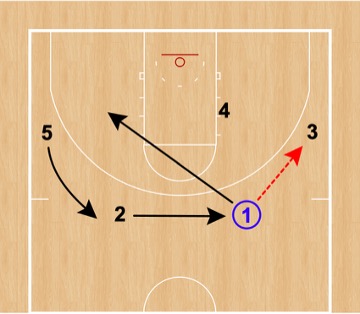
Finally, consider Noah, the basic movements resulting in three distinct outcomes, each unfolding from the same starting alignment:

Outcome #1


Outcome #2

Outcome #3


In what ways are these artifacts similar? How are they different? When were the offenses they depict developed and played? How did the era in which they appeared contribute to their composition?
Let’s start with similarities and differences.
• The starting alignments in Doc and Noah are virtually the same: two guards, two forwards, and a low post. While Doc’s players set up relatively close to one another and to the basket, Noah’s are more spread out, and his 5-man or center is actually not positioned in the low post but offset in an area of the floor contemporary coaches call the “short corner.”
• Mac’s formation takes an entirely different shape, a horseshoe or 1-2-2 configuration, spread across the width and depth of the front court, leaving the middle wide open. The terminology is likely different, too: there is a single point guard at the top of the horseshoe with two wings directly below him near the sideline, the remaining two players positioned in the court’s respective corners.
• The initial pass in Doc and Mac is immediately followed by a basket cut in the direction of the pass, but in Noah, it results in a clearing cut opposite the pass.
• The artifacts are insufficient to fully reveal the overall composition and theory of attack, but a similar scheme for each offense emerges. As a player passes and cuts, his initial spot in the alignment is filled by a teammate. This, in turn, triggers a succession of passes and cuts resulting in a circular movement that maintains the shape of the initial alignment.
• In Doc and Mac, the circular movement of players cutting and replacing one another resembles a Figure 8 or Weave.


This suggests a coaching script that moves every player to pre-ordained spots on the floor, one after another… perhaps indicative of what we call pattern basketball — a highly disciplined, positionless scheme in which every player fills every spot regardless of his size or particular abilities. The emphasis is on continuity as the shape of the offense is endlessly re-created by the scripted movement of all five players.
In Noah, we see a different kind of circular movement, one that remains positionless, but does not endlessly repeat itself.

Instead, each iteration appears to end in a clear decision point — an immediate scoring opportunity or a pass to some other spot on the floor generating its own scoring opportunity and subsequent circular movement.
In other words, it’s not a pre-determined, repeating pattern of movement through which every offensive player must flow, but one requiring constant read-and-react, freelance choices as the ball and players move in relationship to one another.
Let’s repeat several of the Noah diagrams to make this clearer.
In the diagram below, “1” passes to “3’ and cuts away, pushing his offside teammates to move in a circular fashion in front of him. But as the replacement cuts unfold, “3” makes a decision: he drives baseline to the basket, in the process, pulling his teammates behind him in a circular movement, once again, ensuring the shape of the alignment.
And, as the remaining artifacts in the Noah portfolio indicate, there are other options available to the ball handler based on how he reads his defender.
For example, instead of driving, “3” decides pass to teammate “2” who is in the process of filling the 1-man’s original spot in the alignment. But, as this option unfolds, “2” make his own choice. As he moves toward the vacated spot, he senses his defender overplaying him, denying his intended route, so he suddenly changes direction and back cuts to the basket. “3” passes the ball to him as he approaches the basket for a layup.

So, while circular movement seems an implicit element in all three attacks, Noah poses a significant difference to Doc and Mac because it offers so many options for players to improvise.
Based on what our archaeological dig has uncovered so far, Doc and Mac seem to restrict players to a defined pattern dictated by the circle while the Noah attack is largely unscripted, the circular action a by-product or consequence of player choices, not the driver.
Ironically, this difference points to a more profound, strategic similarity between the three offenses.
Regardless of when and under what circumstances each was conceived, the designing coaches were confronting the same questions, ones that have challenged every coach since James Naismith first introduced the game in 1891.
• Scoring occurs at one end of the floor, the front court, a tightly defined area measuring a max of 50’ x 46’ or 2,300 sq. ft. And, in some gyms, particularly in large cities in earlier eras of the game, the space was significantly smaller.
• In the midst of any scoring opportunity, as many as ten players – five on offense, five on defense – will occupy this space and only one of the five offensive players can score at a time.
• Shooting requires time. Not just the physical act of launching the ball toward the goal, but the time required to separate the shooter from his defender so that he has enough remaining time and space to execute the shooting motion. The shooter has to get free long enough to get the shot off. How do we get him that time and space? How do we free him from his defender?
• That leaves four other offensive players (and their defenders) to worry about. Will any of them be involved in assisting the intended shooter to get free? If so, how many? At what point does too many create congestion that will hamper the shooter? What do we do with those not directly involved in shot? How do we get them “out of the way,” but in position to continue the offensive attack if the intended shooter can’t attempt the shot and must move the ball to one of them?
Managing “time, space, and bodies” is the essential challenge that offensive theory attempts to meet and is exemplified in our discussion of Doc, Mac, and Noah.
Remarkably, when we drop the pretense of our fictional archaeological dig to reveal the historic reality of these three offenses, we discover that they rest on a timeline that extends for roughly 100 years. Doc and Noah at opposite ends – in the mid-1920s and early 2020s – with Mac wedged in between them, in 1954.
Each was shaped by the era that produced them and accounts for the differences in their particular approaches to offense, as well as their similarities.
Doc is the work of H.C. “Doc” Carlson, a physician turned coach at the University of Pittsburgh in 1923. Beginning then and continuing into the early 1930s, he developed what many have called basketball’s first true continuity offense, a system he called the “Figure 8.”
Carlson created continuity by cutting the players through the front court using three different pathways: crosswise beginning with a guard-to-guard pass as diagrammed above; lengthwise with passing between a guard and a forward; and diagonally by passing and cutting players from one corner to the other. The direction of each pass triggered the resulting cutting pathway and the movement from one position to the next formed a Figure 8.
For now, we’ll skip illustrations of the diagonal pattern but here’s how the lengthwise pathway unfolded:


Carlson coached in an era when shooting was confined to layups, hook shots and various kinds of floaters in the lane, and two-handed set shots from the perimeter. In each case, separating a player from his defender took time and patience. Consequently, coaches emphasized deliberate, intricate passing and cutting, as scoring opportunities surfaced only when the defense broke down or got “lazy.” There was no shot clock to speed up the possession and force a shot.
Carlson drilled his players in the disciplined nature of each continuity, intermixed them, and finally schooled them to see the natural “breaks” in the pattern where they could score. Amazingly, using Carlson’s crosswise or lengthwise pattern took ten passes and thirty cuts to return every player to his starting position in the continuity. Put them together in the same possession and you double the counts!
Mac is a nickname for the legendary Frank McGuire, the first coach in history to win 100 games at three different universities and the first to lead two of them to the Final Four – NYC’s St. John’s and the University of North Carolina, resulting in a national championship for UNC in 1957.
McGuire called his offense “weave circulation “or the “weave, post and pivot offense,” and insisted that it was neither a regimented pattern offense nor a copy of Carlson’s Figure 8 attack.
Instead, McGuire used the weaving action to balance the formation, separating players from one another and giving way to give and go actions, cutting off the pivot, and ball screening.
“We provide a flexible pattern that permits our players to exercise their individual initiative,” he said. “Throughout the weaving action, the cutters look for opportunities to change direction leading to a give and go, or will set a screen for the man they passed to.”
Recall that McGuire began running his offense in an era when the jump shot had replaced the two and one-handed set shot; shooters could more quickly gain separation, often by their own maneuvering. The entire game sped up, scoring increased dramatically along with shooting percentage.
He not only ran his offense out of the open-middle, horseshoe formation we diagramed above, but in a 2-3 alignment — eerily similar to the Noah attack that takes place 70 years later — with a man set below the weaving action who had compete freedom to roam the pivot area, shooting or maneuvering to the basket anytime he received the ball.


Additionally, the perimeter players could break their weave to pass and run various scissors cuts off him, looking for a handoff as they cut past him, or a return pass as they approached the baseline. This made the offense much more open-ended and fluid than the Carlson approach thirty years earlier.

That brings us to Noah… the first name of basketball guru, personal trainer, and current coaching consultant for the Miami Heat, Noah LaRoche.
After playing and graduating from St. Joseph’s College of Maine, LaRoche founded Integrity Hoops, a basketball training and consulting company in a “dusty New Hampshire gym,” where he moonlighted, training his younger brothers and their friends while working a full-time job in Boston’s financial sector. He soon expanded his services to all age groups and by 2009 had attracted a number of prominent professional players as off-season customers, including Russell Westbrook, Diana Taurasi, and Georges Niang.
That summer he had an epiphany.
He was running a development summer camp for players from different schools and playing lots of 2v2, 3v3, and 4v4, teaching them to “read the floor” and make smart decisions. As the camp progressed, he took “the ten most committed guys” from the group and scheduled games against several successful AAU teams.
“My guys had never run five-on-five offense together… nothing. It was all 2v2, 3v3, and 4v4 small-sided stuff, but against these AAU teams it looked like they had been playing together for years because they were all on the same page… They all knew that if Bobby drives left, we’re all pulling here. If he kicks out, I’m getting a swing. I’m stepping to it… I’m driving again. They knew exactly what was going to happen before it happened. So, then it dawned on me: coaches teach principles on defense, but plays on offense. This makes no sense.”
Nine years later, in preparation for St. Joe’s 2018-19 season, he began consulting arrangement with his alma mater, helping his former head coach, Rob Sanicola, install a new offense based on the principles that had emerged from his training sessions at Integrity Hoops.
He started by asking Sanicola, “What shots do you want and what is the most efficient way to get them?”
There was the only one way Sanicola believed he could increase the team’s scoring and offensive efficiency: layups and standing 3-pt jump shots. To that end, LaRoche helped him build an offense characterized in five broad ways:
• After taking possession, we will advance the ball up the floor quickly, looking for a numbers advantage and an immediate scoring attempt. When denied, our set offense will attack with rapid passing and cutting in place of time-consuming ball screens, pick and rolls, and dribble handoffs.
• Our primary, secondary, and set attacks will flow one to the other using the same cutting and driving principles. When someone drives right, everyone else moves right. Drive left, we move left. This will create passing windows for 3-pointers as the offense unfolds.
• There will be no fixed roles based on floor position. Every player will play every spot on the floor – guard, corner, dunker, and playmaker utilizing the same cutting, driving, and replacement tactics.
• In place of scripted plays or patterns, we will freelance, reading & reacting to one another and the defense using simple “rules” or “guiderails” to maintain space and operational pace. The ball handler will read the defense; his teammates will read him. Every player will pass and cut, attempt basket drives and layups, catch and shoot jumpers, and look for kickouts when denied.
• Our coordinated movement will create adequate room for the ball handler to threaten the defense with an immediate jumper or dribble drive when contested. The rotation or circular movement initiated by the ball handler’s movement will create four known and predictable passing windows for our 3-pt game.
The St. Joe’s offense was quick-hitting, positionless, spread across the front court to open space for drives, used cutting primarily to maintain the desired space, and most importantly, principle-based instead of play-based, leaving on-court decisions to the players, not to the coaches.
The design gave Sanicola what he was looking for: Coordinated movement and spacing of all five players to generate a field goal attempt at the rim or from a standing three-point position on the perimeter, and the simultaneous maintenance of four passing lanes that place the non-shooters in position for a subsequent attempt.
The team’s overnight improvement was dramatic. In one season they increased their points-per-possession from 0.87 to 1.06, moving into the top 1% of Division III performers.
Sadly, we don’t have films of Doc Carlson’s Figure 8 or Frank McQuire’s Weave, but after St. Joseph’s overnight success, YouTube exploded with films of the LaRoche’s system, starting with this one posted six years ago.
Ironically, a short time after “Why NBA Teams Should Study A School You’ve Never Heard Of” appeared on YouTube, LaRoche was hired by the Memphis Grizzlies to transform their heavy ball-screening offense into a more free-flowing, quicker attack.
Unfortunately, the experiment soon fizzled when the Grizzlies’ key player, Ja Morant, grew frustrated with the system’s “egalitarian” principles that removed the ball from his hands and minimized the pick-and-roll plays he preferred. The Grizzlies parted ways with LaRoche and other staff members last March, but the Heat soon hired him to implement a nearly identical system in Miami.
Interestingly, despite Morant’s hissy fit, with LaRoche on board, the Grizzlies saw significant efficiency gains, rising from last in the league in points per game (105.8) to first (123.0 PPG), and reaching a top-6 offensive rating. Similarly, LaRoche’s approach has transformed the Miami Heat from a bottom-tier offensive unit into one of the league’s most explosive teams this season.
In summary, then, our archaeological dig has uncovered three offenses, developed and played in three distinct time periods spread over a span of 100 years, each confronting the same questions of purpose and design. They respond in remarkably similar ways, yet the specific era in which they were conceived has led to important differences.
• In Carlson’s 1920’s Figure 8, we see the interplay of three, tightly scripted patterns run over and over until a shooter can gain separation for a shot attempt at the basket or the time necessary to take a two-handed set shot.
• By 1954, operational tempo has greatly increased with the widespread adoption of the jump shot and the freelance choices it facilitates. McGuire responds appropriately with a more flexible offensive approach.
• Finally, in the 2020s, LaRoche harnesses the impact of the 3-pointer, modern analytics, and a generation of superbly athletic players whose skill sets do not limit them to narrowly defined roles on the court.
In many ways, Doc, Mac, and Noah encapsulate and set the stage for our continuing exploration offensive theory and the evolution of its principles and best practices. We’ll continue the journey in Part III.
Really like the St Joseph offense. “Better than a lay up” should go to every current or aspiring basketball coach.
Noah LaRoche is a very interesting guy. Love how he came to see the distinction between “calling plays” and teaching kids “principles” so that they just “play the game.” Thanks, Chris!
Pingback: Turning Points | better than a layup