
“Why are we starting with offense, Matt?” the Professor asked.
“Because it’s more exciting?”
“No. How ‘bout you, Mr. Hatcher? What do you think?”
“Because you need offense to win?”
“Good try… but no. Offense is the hardest thing to teach. Why?”
“Because it’s hard to get people to play together?”
“Yesssss,” the Professor exclaimed. “It’s like saying, ‘I’m putting $50,000 in cash up here, now come up in an orderly fashion and get your share.’ That’s what a basketball coach does.”
The Professor, of course, was the late Charlie Coles and that’s my paraphrase of a classroom discussion that sportswriter, Grant Wahl, recounted back in 2002 in his feature story on the legendary Miami of Ohio coach.
As they enter the NCAA tournament this week, Miami is the darling of college basketball’s mid-majors, winner of 31 games and ranked in the Associated Press top 25 for the first time since Coles prowled the RedHawk’s sideline 28 seasons ago in 1999 when they went 24 and 8 and made it to the NCAA regional semi-finals. With seven players averaging in double figures, shooting 35% or higher from 3-point range, Miami is currently the best shooting team in the nation, converting 52% of their field goal attempts and averaging 91 PPG.
Win or lose tonight in their First Four game against SMU, basketball junkie and offensive savant Charlie Coles would be very happy.
When Wahl featured Cole’s college credit course on basketball theory in Sports Illustrated, Charlie was the only remaining head coach in the nation’s D-1 schools who still taught such a class. Bob Knight used to teach a similar one at Indiana but had given it up, leaving Coles to carry on the tradition. So, for nine weeks in the early fall each year, Coles would convene a two-hour, twice weekly seminar on all things basketball before his season got underway on the NCAA’s designated annual start date of October 15th.
He liked teaching and had been inspired by the football theory class he had once taken during his sophomore year at Miami, taught by a rookie head coach named Bo Schembechler, one in the long line of coaching luminaries the Oxford college had spawned, making it America’s celebrated “Cradle of Coaches.”
“Best teacher I’ve ever had,” Coles said. “He taught it so well, you ran to class every day.”
After teaching and coaching in high school for nineteen years, followed by six years at Central Michigan College, Coles returned to his alma mater in 1996, coaching basketball and teaching his seminar until retirement in 2012.
“I’ve always enjoyed this,” he told Wahl. “One of the things about coaches now, the students hardly ever see them. They’re famous, but what does a coach do during the day other than coach his guys?”
To the delight of his students, Charlie was a man of enticing aphorisms, peppering his presentations with them and intriguing his students in the process.
“Dribble right at the middle of a 1-3-1 zone.”
“You can’t coach speed, but you can coach quickness.”
“Good offense is like a good shoe; it will fit immediately,”
“If you keep the ball in the middle of the floor, the defense can’t go help-side.”
“High post offenses create space behind the defense, leading to back cuts.”
Predictably, they were mostly about offense, dramatizing the starting point for Charlie’s seminar each season.
“Offense is the hardest thing to teach… because it’s hard to get people to play together… that’s what a basketball coach does.”
The ball is round and has no sides, but to win, you’ve got to be able to play… on both sides. Like me, I suspect Charlie believed that good defense is vitally important… it keeps you from losing, but offense wins championships.
He started with offense both in the gym and the classroom because it was “the hardest thing to teach”… and to learn.
Good defense is a comparatively easier task. You play it with your heart and feet, aligning yourself in relationship to the ball, the man you’re guarding, and to the game’s true north, the basket. It doesn’t take long to master its basic requirements. In competition, you may be disadvantaged by physical limitation – size, strength, and quickness – or waning resolve as good defense demands tenacity over the course of a game, possession after possession. But the spatial requisites of good defense are relatively easy to grasp and execute, even for the inexperienced.
Offense, of course, is an entirely different animal.
It’s complex, a cypher or secret language that can’t be understood without knowing the key that unlocks the code, revealing its principles and axioms, its elements and underlying structure.
In this regard, Charlie Coles was a basketball code breaker, searching for a key to unlock basketball’s enduring principles and best practices for his students and players.
For example, Charlie noted that high post attacks create space behind the defense that that can be exploited with back cuts if the defenders exert too much pressure on the perimeter.

But other offenses reverse this concept, expanding space above the defense to offset the pressure they can exert by packing and isolating the defenders from one another along the baseline, curbing their reaction time because they’re guarding men aligned so close to the basket.
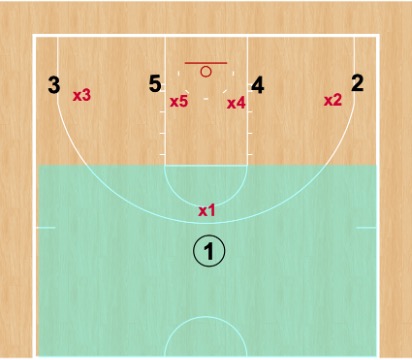
Is one approach more effective than the other. More efficient?
What are the axioms or principles that underwrite each approach? Are they the same but applied differently, or are they fundamentally at odds with one another, existing in contradiction?
If they contradict one another yet are equally successful, does that mean that basketball’s so-called principles are negotiable… that there aren’t any genuine universals or absolutes governing the game?
What, then, are the specific building blocks needed to construct an effective offense? Historically, how did offense evolve and under what conditions?
These are the kinds of questions a basketball code breaker like Charlie Coles asks.
In this post and several to follow, I’ll try to pick up where Charlie left off and continue his exploration. There will be some repetition as I’ve done bits and pieces of this in the past. For example:
• a three-part series on the evolution of shooting;
• several in-depth pieces exploring the concepts of time and space and how they impact both offense and defense;
• the unintended consequences of particular rule changes both inside and outside the game that affected offensive theory;
• how players develop court sense;
• teaching a game of freelance.
This time, though, I want to expand our search, bringing the pieces together in a more comprehensive manner.
We’ll get started in next post, Part II of the Charlie Coles, Where Are You? series.
Great post. Love learning the history of programs and things that we can share with fellow coaches. Keep up the great work.
Thanks so much for your comment. Appreciate it!
I always appreciate your insights. I’m looking forward to the series! Timely! FYI: 10 years ago I had a class track “the winning formula” in the NCAA tourney. Maybe this year I will. Here it is: FTM+TRB-TO = X
Team with the highest number wins. It worked 70+% of the time. It became foundational for how I coached.
Fascinating! Let’s see what happens this tourney.
Mark
You’re so great!
Jim
My coaching days ended many years ago. I wish I had you as a resource back then. Good stuff. Thank you
Chris, great to hear from you. Thanks for continuing to read my stuff. Hope all is well!
Pingback: Charlie Coles, Where Are You, Part II | better than a layup